USO Connection
Fall 2026 Newsletter
Welcome to uso connection
Here, you can read about how your support makes an impact for America’s service members around the world. We hope you enjoy these stories. Visit our website to learn how you can support the USO.
Deployed Service Members in Kenya Now Have a Place to Call Their Own at the USO
For American service members deployed in Kenya, conditions can be challenging. The hot desert environment is intense and austere, and their safety brief even includes how to interact with local monkeys. After long days conducting operations in these remote conditions, something as simple as a USO event can lift spirits and provide a sense of normalcy in a completely new and isolating environment. Now, service members forward-deployed to Kenya have crucial support to help ease that isolation: their first staffed USO Center.
Read More
“The ability to come chill in a space catered to me really helped me decompress after a long 12-hour shift,” said one service member. “I love being able to come in, see a friendly face, grab a cup of coffee and play spades with others.”
From the moment the USO team arrived in Kenya, they got to work – meeting with military leadership, assessing the site and planning fun events to meet the needs of the military community on base. Within weeks, the team launched their first volunteer orientation and welcomed more than 20 service members to the USO Volunteer ranks. These troops will volunteer at the Center in their downtime after carrying out their military duties, and are excited to help bring the USO mission to life on base.

USO staff and volunteers overcame logistical challenges and months-long supply delays to transform a small facility into a fully functioning USO Center in Kenya.
Designed with comfort and community in mind, the new USO Center offers the people who serve in Kenya a place to step away from daily pressures of a deployment. That could mean enjoying a fresh cup of coffee from the coffee bar, grabbing a snack, playing cards with friends or simply relaxing under the covered patio and taking a break from the sun. With books, games and regularly scheduled fun programs, the USO Center in Kenya gives service members the chance to unwind and connect.
For many, the difference has been immediate. “Off days had a different meaning when the USO came to town,” shared Sgt. Traylon Wainright.
As military operations increased during the holiday season, service members navigated additional restrictions, sometimes confined to their rooms with little time to interact with each other. The USO adapted quickly to these new conditions, finding ways to bring holiday cheer and maintain a sense of connection, even in isolation.
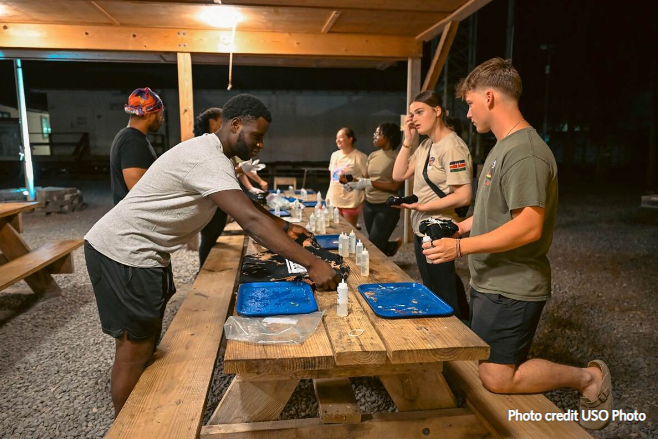
Designed as a place for deployed service members to relax and recharge, the USO Center in Kenya offers coffee, games, programs and a welcoming space to connect away from the pressures of deployment.
Behind the scenes, building the USO presence on this base came with its own challenges. With mail running slower than usual and supplies taking months to arrive, USO volunteers played a critical role in helping transport, organize and set up more than a dozen pallets of materials. Once they had the supplies they needed, USO staff and volunteers transformed a small facility into a fully functioning USO Center.
“With supplies on hand, we started to carve out a space that truly felt like the USO,” said Heather, a USO staff member on site. “Volunteers raised their hands to be part of building something meaningful for the entire community.”
That sense of ownership and pride can be seen in every part of the Center. Service members took the lead on setting up the coffee bar and an area for the USO Reading Program, where troops can record themselves reading a children’s book that they can send back home. They also work closely with USO staff to help establish a regular calendar of events that service members can look forward to each week.
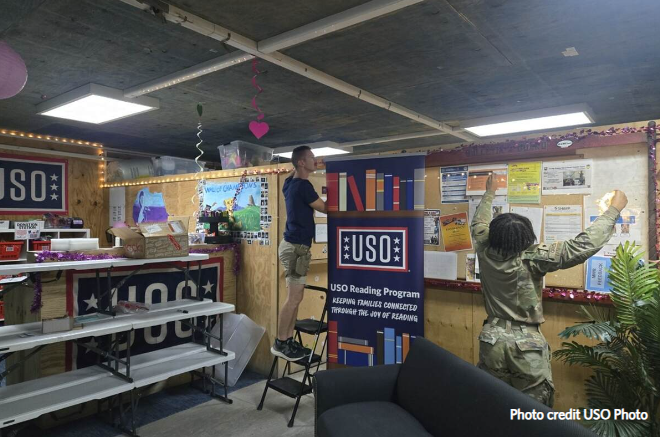
Service members helped shape every part of the new USO Center in Kenya, from setting up the coffee bar to creating a space for the USO Reading Program, where troops can record themselves reading children’s books to send home to their families.
USO staff living and working on site have partnered with military leadership on base to deliver programs specifically catered to these service members to boost morale and foster connection. Some of the service members’ favorite activities include shared meals, movie nights and simple moments of conversation. In locations where resources and recreational opportunities are limited, the presence of the USO creates meaningful moments of normalcy.
“As someone who has both served and now supports service members in austere locations, I’ve seen how quickly a community can shift when the USO arrives,” said Heather. “What was once routine and monotonous becomes something people look forward to. It’s amazing what a warm smile and something as simple as coffee or a homemade treat can do.”
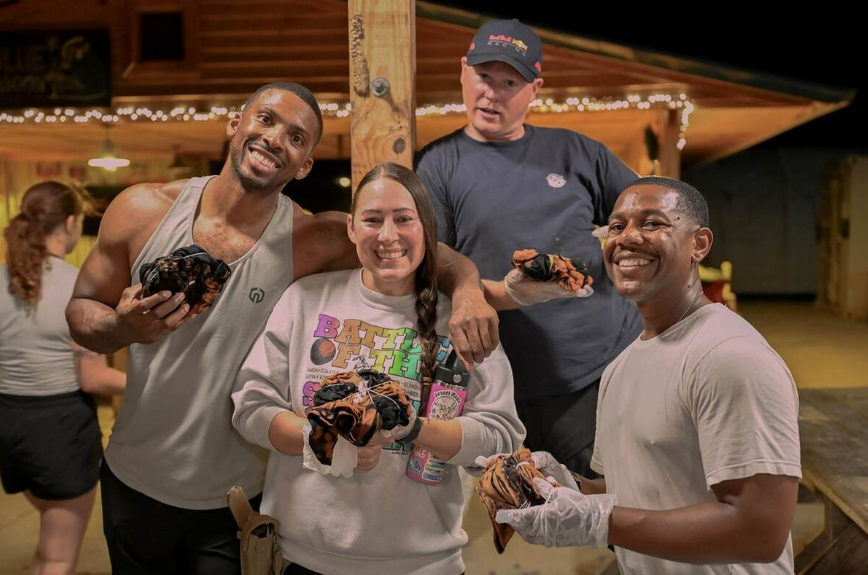
Even small moments can make a big impact. Two service member volunteers first heard about the USO’s arrival when they learned USO staff member Heather was making pumpkin spice lattes.

Two service member volunteers first learned the USO had arrived in Kenya when they heard USO staff member Heather was making pumpkin spice lattes on base. | Photo credit USO Photo
“We couldn’t believe our ears. It was mid-November, and we had just confided in each other about how much we missed our fall traditions – pumpkin spice lattes being number one. So, when we heard the USO was here and they had PSLs, we knew it was going to be alright.”
Those early moments of coming together at the USO Center quickly grew into something bigger. With the help of dedicated volunteers, the USO has expanded offerings on base, helping establish a regularly stocked coffee bar that brings people in to socialize,as well as expanding the Center’s programming to further USO support. Whether picking up a book or tie-dyeing a shirt to work out in, service members in Kenya now have consistent opportunities to relax, recharge and take a moment to just be themselves at the USO.
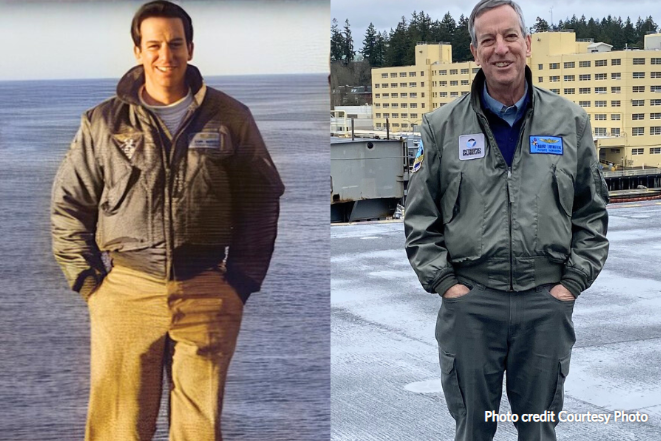
From a Supporter Like You: CDR (ret.), MC (FS), USN Harry Livenstein
As a Navy veteran with eight years of active-duty service and 24 years in the Reserve, CDR (ret.), MC (FS), USN Harry Livenstein’s connection to the USO has grown stronger each year — first, as a service member who enjoyed the hospitality and kindness of the USO, and now as a loyal supporter of the USO for more than a decade and counting.
Read More
After years of supporting his fellow service members as a Navy flight surgeon and emergency medical specialist, Dr. Livenstein has now helped create a place of support for the next generation of U.S. Navy sailors and crew by funding the USO Center aboard the USS Nimitz, the aircraft carrier on which he once served.
From Land to Air to Sea
Dr. Livenstein was confident in his dream of becoming a doctor, even from a young age.
At age 15, when it was time to dissect a frog in his high school biology class, located in the suburbs of New York City in Westchester County, Dr. Livenstein recalled that his lab partners were joking around and poking at the frog – but he was quick to bring them back to the task at hand.
“It’s a silly story, but I still remember. I kind of yelled at my three classmates, and I said, ‘Hey, we’ve got to take this seriously! I’m going to be a doctor. It’s really important for me to dissect this frog.’”
But he was almost as passionate about another interest: airplanes and flying. A few years later, while studying at Colgate University for his undergraduate degree and volunteering to be his college newspaper’s photography editor, he kept that fascination in mind.
“I convinced the editor-in-chief to pay a pilot to take me flying in a little Cessna airplane to take aerial pictures of the campus. Flying in the plane was my major motivation,” Dr. Livenstein said. “I was already thinking about getting a pilot license myself.”
With the rigors of medical school ahead, he thought flying planes would be just a hobby, but eventually it would become a key part of his career in the U.S. Navy.
Dr. Livenstein considered joining the military a few times while he attended medical school – first through the Health Professions Scholarship Program offered by the Air Force, and then again through the Navy. However, each time, he determined it wasn’t quite the right time. However, his experience with the Navy recruiting office stayed with him – he had been introduced to the role of “flight surgeon,” and he was intrigued.

Flying began as a hobby — but the idea of becoming a Navy flight surgeon, combining his passions for medicine and flying, stuck with Dr. Livenstein and eventually shaped his career. | Photo credit Courtesy Photo
“The military calls it ‘flight surgeon,’ going back a hundred years, when all doctors were ‘surgeons,’” Dr. Livenstein explained. “Essentially, it’s primary care for pilots and aircrew, considering how common day-to-day medical issues and problems can affect someone whose job it is to fly a $30 million national asset.”
As a flight surgeon, Dr. Livenstein could apply his experience and knowledge of clinical medicine and human performance in aviation settings to ensure that service members were medically and psychologically fit to operate aircraft and support flight missions.
Dr. Livenstein graduated from medical school in 1982 and continued with internship and residency, but he often thought about becoming a Navy flight surgeon. He left residency early and joined the Navy just two years later, and while he was eager to dive headfirst into the approximately six months of required medical training, he was especially excited about the six-week flight school that was part of the training. Finally, his two passions were combined – medicine and flying – and he accumulated 35 hours of dedicated flight instruction in the same aircraft that naval aviators first learn to fly.
“The opportunity to fly what – at the time – would have been about a $3 million turboprop airplane was the coolest thing in the universe. To get paid for learning to fly was a bonus.”
During this training, CDR Livenstein and one other student flight surgeon trainee were the only students out of a class of 18 who soloed a Navy T-34C training aircraft.
“To this day, I’m proud of that,” he said.
During his eight years of active duty, CDR Livenstein accumulated a total of 500 Navy flight hours, mainly as a helicopter second pilot, including 26 carrier arrested landings (also known as “traps”), two tours with HSL-30 helicopter squadron, a deployment with the Carrier Air Wing CVW-8 on the USS Nimitz and both “Blue Nose” and “Shellback” status – while also earning his private pilot license and instrument rating.
He planned to serve the required three years and then continue his civilian medical career, but an unexpected opportunity led to eight years of active duty when CDR Livenstein traded his shore duty billet for a sea duty billet.
“I decided I like this Navy stuff,” Dr. Livenstein joked.
“I was so excited. I knew for me, it would be a one-shot deal,” he explained, as sea-duty flight surgeon opportunities are few in number and he did not plan to specialize in aerospace medicine, which likely would have involved multiple sea duty deployments.
He deployed on the USS Nimitz, a nuclear-powered aircraft carrier, in the fall of 1986 for a training exercise off the coasts of Iceland and Norway, and again in 1987 for a six-month deployment in the Mediterranean.
It was the experience of a lifetime for him.
“I loved being at sea,” CDR Livenstein said, explaining that he especially loved having the occasional opportunity to go flying in an F-14 Tomcat or an A-6 Intruder.
He also joked that he got the best sleep of his life while at sea on the USS Nimitz: “There was something about the bunk bed and the gentle rocking of the ship. I used to skip lunch and take a nap instead – I could have slept on that ship for 20 hours every day.”
It was during these deployments that CDR Livenstein had his first profound experience with the USO. He distinctly recalled when the USO flew a country music band out to the aircraft carrier in the middle of the ocean to perform for the service members onboard, as part of the iconic USO Entertainment tours and in an effort to boost morale.
Dr. Livenstein spent 24 years in the Navy Reserve after release from active duty, filling in for other flight surgeons or emergency medicine doctors, typically two weeks at a time, in locations that included Bahrain, Spain, Greece and Japan. He was also mobilized to Afghanistan for five months, just a year after he was eligible for retirement.
“It only took me a few weeks at Kandahar Airfield to tell myself I should have retired earlier,” he joked, before then adding seriously:“Thankfully, there was a USO Center on the base.”
While he was in the Reserve, Dr. Livenstein continued to practice medicine in the New York City area, where he completed his emergency medicine residency and then worked at several New York and New Jersey hospital emergency departments for the following 25 years. During that time, he also logged more than 1,800 pilot-in-command hours as a private pilot and bought his own Cessna airplane.
A Decades-Long Relationship with the USO
As someone who loves to fly, even if not in the cockpit, Dr. Livenstein made racking up frequent flyer miles his newest favorite hobby approximately 25 years ago. And through that hobby, he has visited many USO Centers.
As a reservist, he visited USO Airport Centers several times a year while traveling for duty and personal travel. He knew that whenever he saw that familiar red, white and blue USO logo, he would receive a warm welcome from USO staff and volunteers, along with drinks, snacks, comfortable seating, TVs and internet access.
As a USO supporter, he often designates his USO support toward specific USO Centers that he has visited, including airport Centers in Denver, Chicago, Newark, New York City and especially the Bob Hope USO Center at Los Angeles International Airport.
“Maybe this sounds immature for a 40 or 50 or 60-year-old man, but the Bob Hope USO was one of my happy places,” Dr. Livenstein said. “When other frequent flyers discuss this or that fancy airport lounge, I always smile to myself and think how much more I enjoy and appreciate a USO airport Center.”
As a frequent visitor to the Bob Hope USO Center at Los Angeles International Airport, he could always expect a chili cheese hot dog and his favorite brand of doughnuts upon his arrival.
“For me, it wasn’t a visit to LA to see cousins or to attend a medical or frequent flyer conference without two stops at the Bob Hope USO,” he said. “Once upon arrival and once upon departure. I’d get a hot dog and this specific donut brand, which I got hooked on in Norfolk and weren’t available near New York City.”
One visit, when the Bob Hope USO Center was out of those specific doughnuts, a USO staff member recognized Dr. Livenstein and – with the exceptional hospitality that the USO is known for – went out to buy him those favorite doughnuts so that they would be ready for him on his next visit to the Center, prior to his return flight home a few days later.
“My affection for the USO is deep and goes back many, many years,” he said. “And since the USO O’Hare and Bob Hope USO Centers function as staging points for sailors and Marines in airports on the way to or from boot camp, I always understand when a USO Center is so crowded with active duty personnel that they cannot accommodate a reservist or a retiree. The young enlisted appreciate it even more than I do.”
So, when the opportunity came about for him to come full circle and support the building of a USO Center aboard the USS Nimitz, he jumped on board – this time literally and figuratively.
“I was very excited to sponsor the Nimitz USO Center, since that’s where I did my sea duty,” CDR Livenstein said. “When I saw the Center in-person at the ribbon-cutting and spoke with the skipper and the chaplains, I knew my support was very well placed.”
The initiative to build USO Centers aboard warships and Navy aircraft carriers began a few years ago, in partnership between the USO and the Navy, to help service members better handle the physical and mental challenges they face when at sea for several months at a time.
Being surrounded by walls of grey metal and the sound of jet engines for 6-9 months straight, while living in cramped spaces with little privacy, all while dealing with the monotony, isolation and constant work stress can take a toll on sailors and Marines out at sea. Many of these service members just want to go someplace quiet, someplace relaxing, someplace unlike any place else on a Navy ship where they can recharge, take a break from the stressors of their duties and connect with the people and activities they love.
And that is exactly what the USO Center onboard the USS Nimitz is for.
“This new Center is very significant with its current deployment to the Middle East,” CDR Livenstein said, highlighting the Nimitz’s role in maintaining order in the region amidst heightened tensions. “I feel like that’s very impactful to have a USO Center there when they’re under such pressure on such a high-tension deployment.”
Ship-based Centers have many of the same amenities as brick-and-mortar USO Centers, including internet connectivity, computers, TVs, electronic gaming equipment, snacks and beverages, libraries and more. Crucially, many of these USO Centers on ships have soundproof phone booths, where service members can privately speak to a loved one in an environment where privacy is hard to come by.
These Centers also provide comfortable seating and a home-like environment that offers service members a break from the cold and stark atmosphere of a ship.
“I think someone who hasn’t been in the military, even more so someone who hasn’t been in the Navy, and even more so someone who hasn’t served any significant amount of time at sea … I don’t think they can fully understand just how much of a game changer this is,” CDR Livenstein said.
“On the Nimitz, the USO Center is three complete rooms that look like they could be in the library or the den in your home. Nice, comfortable furniture and nicely painted walls, and a ceiling that isn’t a bunch of pipes and wires and valves,“ Dr. Livenstein continued. “The contrast between the USO Center and enlisted berthing and dining is so dramatic, so significant, that it would take someone who’s unfamiliar with a Navy ship only a millisecond to see it and realize the importance and significance of a ship-based USO Center.”
A comfortable environment and basic amenities may seem simple to the average person, but they can have a powerful impact on the daily lives of sailors and crew members — especially when it comes to their mental well-being and morale. In fact, the U.S. Navy’s suicide rates among sailors have continued to increase, and as a result, the branch has taken serious efforts to support mental health among its ranks – including building more USO Centers aboard its vessels. This is critical during recent deployments, some of which have seen some of the most intense combat by the U.S. Navy since World War II.
When thinking about how the USO Center aboard the USS Nimitz – and other ship-based Centers – will be used, CDR Livenstein often thinks of the newest generation of seafaring service members, who are adjusting to a new way of life and facing the challenges of deployment.
“I am fortunate and blessed to be able to support service members in this way and to be in a position where I can support the USO. It feels wonderful,” he said.
Dr. Livenstein emphasized that for him, the importance of a USO Center isn’t measured in donated dollars, but in lives touched. Recognizing the unique pressures of life at sea, he sees these Centers as a vital lifeline for sailors’ well-being. And CDR Livenstein’s contributions are already having a positive effect. In June 2025 alone, the USO Center aboard the USS Nimitz had 8,553 visits from service members.
“Thank you for all that you do. It is truly a blessing to the sailors on this ship,” shared a U.S. Navy chaplain aboard the USS Nimitz, who explained that the ship has recorded an approximately 400% increase in usage of the space since the USO renovated it and turned it into a ship-based USO Center.
From airport terminals to aircraft carriers, from USO Centers on bases to the open seas, the USO stands beside service members at every point in their military journey – and it is all thanks to the support of our generous donors. For sailors aboard the USS Nimitz, the new USO Center is more than a place to relax — it’s a reminder that no matter how far from home they sail, they are never alone. Thanks to supporters like Dr. Livenstein, the USO can continue to create these moments of comfort and connection, ensuring that wherever their mission leads them, service members know the USO is there for them.

STRENGTHEN THE WELL-BEING OF AMERICA’S MILITARY AND THEIR FAMILIES WITH A DONOR-ADVISED FUND
It takes a force to keep our service members strong, and a donor-advised fund (DAF) is one of the smartest ways to do just that. If you’ve already established a DAF, you hold the power to direct it toward the moments that matter most: a service member’s first deployment, a family navigating the strain of separation, or a veteran’s first steps back into civilian life. Recommending a grant to the USO means your generosity reaches wherever the mission calls.
A DAF lets you grant funds whenever you choose, with no added tax burden, since your contribution was deductible the moment it entered the fund. That means your support can move as fast as the needs of the men and women who serve. Your DAF lets your impact go exactly where it’s needed most. Learn more about taking the next step with your DAF.
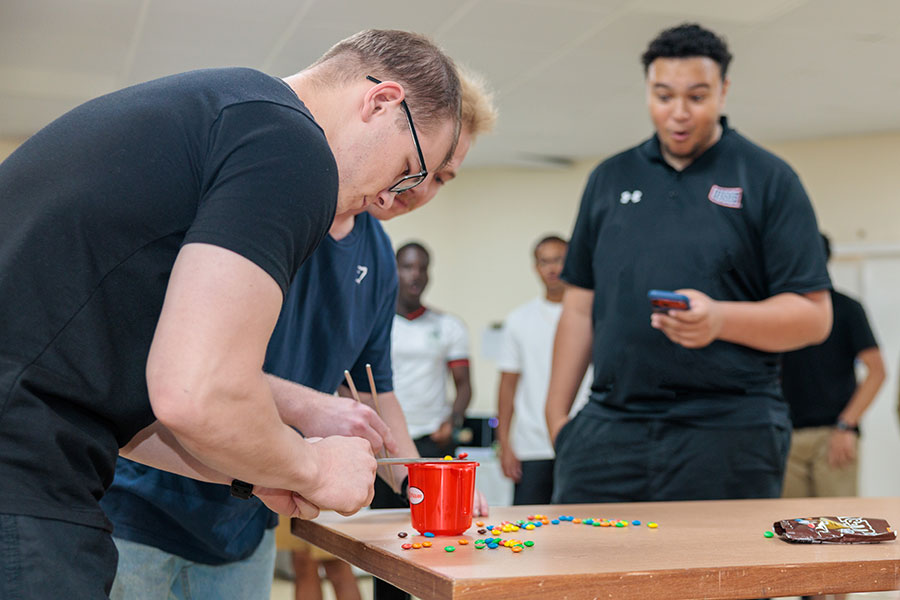
Making it Fun, Even in the Desert
Deep in the Jordanian desert, about 100 kilometers east of Amman, Muwaffaq Salti Air Base isn’t exactly known for its entertainment options. But for the CAV unit deployed there, a week of USO-hosted tournaments turned an austere location into something that felt a little more like home.
Read More
Blackjack. Uno. Karaoke fueled by McDonald’s between songs. And Blind Mario Kart — which, it turns out, reveals more hidden talent than anyone expected.
“This group can make anything fun,” said USO Center Operations Manager, Dundrey Peoples.
“Lindsay and I were blown away at the hidden talent a few service members were hiding. Other pairs were less skilled but still entertaining to watch!”
The energy in the room said everything. In some of the most isolated corners of the world, the USO shows up — and your support makes that possible.

USO Financial Wellness
Hanging up the uniform is one of the most significant transitions a person can make, and one of the most challenging. The skills are real. The discipline is there. But translating years of military service into a civilian résumé, a job interview, or an enrollment application is a different kind of mission, and many service members face it without a clear roadmap. That’s where the USO steps in.
Through USO Transitions, active duty, Reserve, and National Guard members and military spouses are matched with a personal USO Transition Specialist — at no cost — who walks alongside them as they build their plan for what comes next.
From résumé writing and interview prep to professional certifications through Coursera and Skillsoft, to access to a network of mentors and veteran-seeking employers, the USO provides the structure and support to help service members step confidently into their next chapter. Your generosity makes every one of those conversations possible.
Join the USO 1941 Legacy Society Today
The USO 1941 Legacy Society is a special group of supporters who have made a transformational commitment to supporting US service members around the world. Members of this dedicated group of supporters are not only making a lasting impact on our mission, but are also eligible to receive invitations to special events, exclusive impact reports and recognition in our publications.